Archive for June, 2012

New translation feature for Facebook

Facebook has rolled out a new translation feature to users’ profile pages. The social network site has teamed up with search engine Bing, to provide a translation link on comments which are posted in another language. The translation feature, which has been available on fan pages for a while, will allow users to click a link and the translation will pop up in your preferred language. Good news for those of us with international friends whose language we can’t speak!

Comments off

Phonics tests for 5 and 6 year olds

This week, children across England will be participating in mandatory reading checks. The Year One children, (ages five and six) have been learning to read using the phonics system. The tests are to measure how well the pupils are learning to read using the sounds of each letter and putting them together to form words.

The test will take between 5-10 minutes, and will ask pupils to read 20 real words and 20 made up words, such as ‘terg’ and ‘spron’.

The Association of Teachers and Lecturers, the National Association of Head Teachers and the National Union of Teachers issued a joint statement, saying:

“The use of made-up words will confuse children for whom English is a second language and those with special educational needs as well as frustrating those who can read already. There are already enormous pressures on teachers to teach to the test, so how long will it be before children are being taught to read made-up words?”

The Government’s phonics-only approach to teaching reading is controversial. Most teachers advocate a balanced mix of methods, including flash cards and the ‘look and say’ method, because not every child learns the same way or at the same speed.

Comments off

Britain last in Europe for second language fluency

A study by the European Commission shows that Britain is at the bottom of the list for student’s ability to speak a second language. Malta and Sweden scored highly, with 82% of students being able to demonstrate skills in a second language fluently.

Tests were carried out in 14 of the 27 European Union countries. Only 42% of pupils were competent in a second language. It was revealed that British students had a poorer grasp of the basics of a foreign language than pupils in the other nations tested.

The five most widely spoken second languages were:

1) English – 38%

2) French – 12%

3) German – 11%

4) Spanish – 7%

5) Russian – 5%.

“We must do more to improve the teaching and learning of languages,” said education commissioner Androulla Vassiliou. “Being able to communicate in a foreign language broadens your horizons and opens doors.”

The study results come just weeks after the Government announced plans to make languages compulsory in primary schools.

The only problem is, where are all the language teachers going to come from, since so many from previous generations haven’t learned a language sufficiently?

Comments off

Blog censorship

You may have read about Scottish schoolgirl Martha Payne’s NeverSeconds, a blog focussing on Martha’s school dinners. She uploads a photo of her lunch every day and rates it. Martha also posts photos of lunches she has been sent from other schoolchildren around the world, as well as raising money for charity Mary’s Meals, which provides school lunches for the poorest communities all over the world.

Argyll and Bute Council claimed that the nine year old’s blog was attracting negative attention, and implemented a ban on photography in the school canteen, after one of her photos was published in a Scottish newspaper with a less than flattering headline. They issued a statement saying that the blog was a “misrepresentation” of the food choices offered to pupils at the school.

The ban has now been lifted after public uproar, and Martha will be resuming blogging about her school dinners today. The publicity the row has attracted means that Mary’s Meals has now raised enough money to feed 1963 pupils in Malawi school meals for an entire year.

Good on you Martha! This should never have happened in the first place. Students should be encouraged to do this sort of thing; as Martha has proved, she is not only is she communicating with kids all over the world, but also writing on a regular basis. Too many pupils in the UK leave school without a basic knowledge of English spelling and grammar.

Comments off

Foreign languages to be introduced in schools earlier than ever before

Great news for British schoolchildren this week comes with the announcement that languages will be made compulsory in schools again, from September 2014.

With Brits trailing behind the rest of the world when it comes to being multi-lingual, this can’t come soon enough in our multi cultural society. Both Spain and Belgium introduce learning a second language to pupils aged three.

Education Secretary Michael Gove announced that foreign languages will be part of the National Curriculum for all children from the age of seven; earlier than ever before. Previously, languages were compulsory only at high school, with a second language being optional for GCSE education.

There will also be new focus on spelling and grammar. The plan outlines the knowledge which every student should gain each year.

By the end of Year 1, pupils will have progressed from spelling simple words, such as drip, kiss and leg, to compound words, such as ­playground and bedroom. They will know basic sentence structure and punctuation.

In Year 2, they will be taught ­contractions (I’m, isn’t), ­homophones (their, there, they’re) and possessive ­apostrophes, as well as the spelling of words including fridge and thumb. They will be expected to know about ­subordination (if, that), co-ordination (or, and, but) and using the past and present tense.

In Years 3 and 4, pupils will be expected to know how to use complicated suffixes, when to double the final consonant (forgetting and gardening) and the use of the “shun” sound (-tion, -cian).

By the end of Year 3, they should be able to express time and cause using conjunctions (when, before, after), adverbs (then, next, soon, so) and prepositions (during, in, because of).

By the end of Year 4, children will have been taught fronted adverbials, the use of speech marks and the use of ­possessive pronouns.

By the end of Year 5, pupils will be expected to know about relative clauses beginning with who, which, where, why, or whose, how to indicate possibility and how to avoid ambiguity through the correct use of commas.

By the end of Year 6, they should understand complex noun phrases (e.g. the boy that jumped over the fence is over there). They should also be able to spell words with silent letters, others such as harass and accommodate and the letter string “ough”.

This is great to see, as having a basic understanding of building sentences and phrases in English is paramount to being able to successfully learn a second language. I was never taught the theory of language structure at school, and as a result, have had to almost learn English all over again in my bid to help myself learn Spanish.

For the first time, the Government will issue a list of words that students must be able to spell. Also for the first time, Mandarin will be part of the Curriculum, as well as Latin and Greek. Latin forms the basis for understanding the roots of words for a lot of other European languages, so this is another exciting addition, although I do wonder if there are enough Latin teachers to implement this.

I’m excited to see this plan, I know that it would have helped me at school. It will be interesting to see how this pans out though.

Source: The Mirror

Comments off

Anyone speak binary?

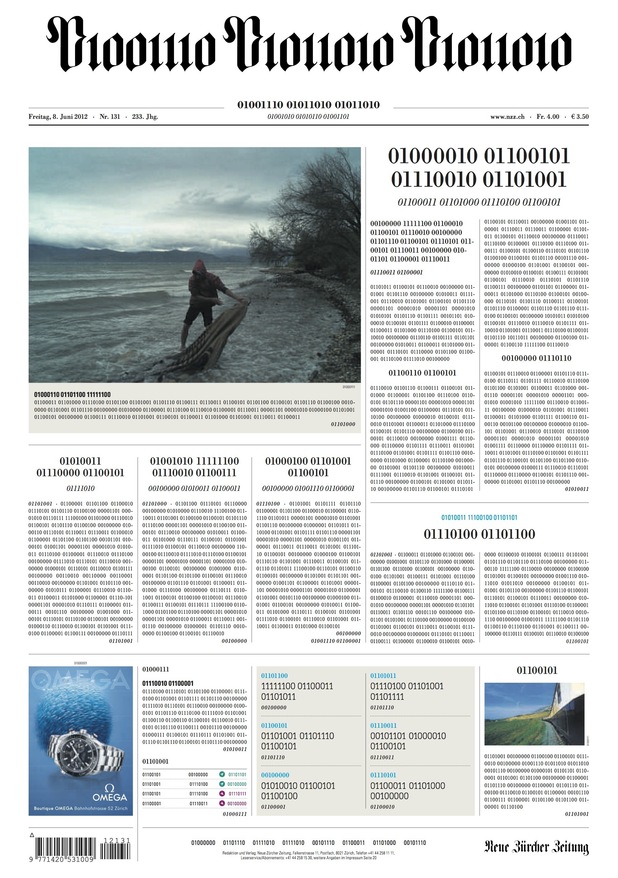
Swiss newspaper  Neue Zürcher Zeitung published their entire front page in binary on Friday (June 8th). Details such as the publication’s website, date and price remained in the original form. The reason? The newspaper was celebrating its first digital edition. You can ‘read’ it here. (The German front page is on page 3, and the rest of the paper was printed as usual, so you won’t be needing this translation tool.)


Comments off

The untimely demise of the Queen’s English Society

The Queen’s English Society, a group formed in 1972 to publicise the need for good grammar and spelling in written English, have announced the closure of the group, citing disinterest from the public.

The announcement has attracted a lot of mockery from the media. At a time when a lot of people are using text speak as the norm, has the Society chosen to close at the wrong time?

Languages evolve and change, there is no doubt. Currently, with the evolution of technology and social media, certain restrictions on space and characters limit the way we communicate. But does this mean that the use of “good English” is diminishing?

My personal opinion is that there is a need to differentiate the situations and mediums in which the language is used. Where you might not have enough space to write “to” in a text message or Tweet, the substitution of “2″ would be acceptable. On your CV or in a formal letter, however, not so much. Yet it is happening more and more. I also see a lot of people write the way they would speak, rather than in the correct written form – e.g. “I would of…” instead of “I would have…” I have personal experience of witnessing this, seeing a lot of CVs submitted per week at my work. I wouldn’t say that I’m the best at grammar or spelling, nor would I say that I use the “Queen’s English,” but know enough not to use diminutives in a professional scenario.

So, does the closure of the Queen’s English Society even matter? What do you think?

Comments off

Berkshire school opens Mandarin teaching centre

A new Mandarin teaching centre opened at Wellington College in Berkshire on Saturday. The £500,000 centre is apparently the largest of it’s kind in the UK, and has a pagoda and Chinese water garden. The centre will not only teach students, but also host Chinese cultural events.

Liu Xiaoming, China’s ambassador to the UK, opened the centre as part of the schools’ Speech Day programme on Saturday. Speech Day honours outstanding students, with exhibitions of their work, sports displays and games, and prize ceremonies. Wellington College is a 150 year old independent school and is known for it’s Chinese links, as it has a sister school in Tianjin, near Beijing.

Comments off