Archive for sign language

Finger spelling

Exciting to see this on the BBC website this week! Hot Fingers is a BSL finger spelling competition; the main aim of which (other than fundraising!) is to set the fastest time spelling out words with your hands.

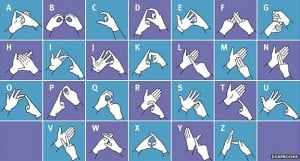
Finger spelling is a method of communicating the alphabet using hand movements. It’s used primarily to spell out names, as well as words which don’t have a sign, or words you don’t know the sign for! It’s pretty time consuming so you wouldn’t be able to hold a full conversation using just finger spelling!  Other sign languages spell the alphabet using just one hand, but in British Sign Language, we use both hands.

As the most basic form of sign language, it is also a great way to introduce yourself to British Sign Language. I learned this when I was very young, and the best tip I can give is to learn the vowels first. Why that’s the easiest thing to learn will become clear when you look at the guide below!

BSL fingerspelling chart

Comments

Deaf Awareness Week

Next week (6 – 12th May) is National Deaf Awareness Week.

Lots of events around the country have been organised to raise awareness. In Norwich, deaf and hearing children from local schools will gather at the city’s Forum to perform songs by One Direction, amongst others, in sign language.

Norfolk also has two sign language choirs. Jenny’s Signing Angels and V-Sign will both be performing at the Forum on Wednesday 8th May between 10am-3pm.

This is Sally from the Signing Angels performing Alanis Morrisette’s Ironic in British Sign Language.

Comments

Hawai’ian Sign Language

A team of researchers from the University of Hawai’i at Manoa are working to record and revive the dying language of Hawai’ian Sign Language.

They have located and identified 40 users of the language over four of the islands, most of whom are over 70.

James Woodward, a Professor of Linguistics at the University of Hawai’i, says

What we find with Hawai’i Sign Language is that 80% of this basic vocabulary list is different.  It means it cannot in any way be related to American Sign Language.

Hawai’ian Sign Language is believed to have originated in the 1800′s, long before American Sign Language. These are now the only two surviving sign  languages in the United States.

The team are documenting Hawai’ian Sign Language with instructional videos, illustrating the distinct differences between Hawai’i Sign Language and American Sign Language. They hope that the older generation of HSL users will be able to teach younger deaf students to sign and keep the language alive.


Comments

CBeebies announces sign language programme

Children’s television channel CBeebies is to air 30 episodes of a new show entitled Magic Hands as part of the spring schedule. The 5 minute programme, aimed at children under 6, will be in BSL (British Sign Language) and is to feature four presenters who have been deaf since birth and are new to our screens.

This is a groundbreaking show for British television as the aim of the programme is to bring to life a mix of modern and classic poetry using sign language, animation, music and spoken word.

Series producer, Judith Bunting, says:

“Translating modern and traditional poems for children into BSL on such a scale is a first. There are deaf poets and deaf theatre companies but no national television company has ever tried translating children’s poetry into BSL. It was a mammoth task and our artistic interpreter has done an amazing job, taking the intricacies of verse from the 19th to 21st centuries and transforming them into a terrific series of performances.”

Each episode is based around a single verse of poetry and the selected poems are diverse, ranging from Maya Angelou to Shakespeare.

Comments off

More success for Irish students’ sign language app

A new smartphone app which helps teach sign language has won another award.

Sign4Life was developed by secondary school students from Salesian College in Co. Limerick, as part of their Transition Year project. The app, which is now available on Android; is aimed at friends, family and teachers of the deaf, and is designed to help bridge the gap between the deaf and hearing communities through video technology.

In March, the five students won the regional finals of Junior Achievement Ireland. They followed this up in May by taking the All-Ireland National Junior Achievement title.

Caoimhe O’Neill, Ciara Reidy, Colleen Mullane, Chris O’Brien and Fiona Mangan then competed against teams from 32 countries at the Junior Achievement Young Enterprise  European Final, which was held in Bucharest, Romania. The girls won the prestigious Company of the Year award at this event, after making a presentation and undergoing an in depth interview with the judges.

“We have seen so much, we have learned so much. With some things, you have to make an effort. It isn’t going to come to you,” said team member Caoimhe O’Neill.

In addition, the UK team, Vitamin Boom, won the FedEx Access Award for their Super Froo-Tea tea bags and iced tea products, which contain Baobab.

The Junior Achievement programme is part of a worldwide organisation, and aims to bring enterprise to the education system, and give students hands-on experience of running their own business. The organisation uses mentors from local businesses to help students through the process.

Comments off

Ukrainians design sign language translation gloves

A team of Ukrainian students have designed a pair of gloves which are capable of converting sign language into speech. The battery operated gloves contain a complex system of 15 sensors which translate hand gestures, using a smartphone app via bluetooth technology, into soundwaves. They then utilise Microsoft Speech and Bing API to translate the soundwaves into speech.

The creation, which is called Enable Talk, recently won first prize in Microsoft’s Imagine Cup, a technology design competition open to students all over the world. The team of four students; Valery Yasakov, Anton Pasternikov, Anton Stepanov, and Maxim Osika from Computer Academy Step in Donetsk, who call themselves Quadsquad; won the prize for best software design.

The prize money is equal to £16,500, and is more than half of what the team need to start pre-production on the line of gloves, which are currently in the prototype stages.

Quadsquad team member Maxim Osika said:

“We were inspired to help our friends who are hearing and speech-impaired to have the ability to communicate like everyone else.”

Comments off

ASL vs BSL

Paul McCartney’s music video for his latest single My Valentine features actors Johnny Depp and Natalie Portman using sign language to convey the lyrics of the song.

It has been widely reported that there are some errors in the sign language used, most notably, that both actors use the sign for ‘tampon’ rather than ‘appear,’ and ‘enemy’ instead of ‘Valentine.’ Whilst in British Sign Language, the sign is for ‘tampon,’ it’s important to note that the actors are using American Sign Language, for which the signs for some words differ slightly. Therefore, the sign they used to signify ‘appear’ is correct. There are actually two ASL signs for the word ‘appear;’ one means ‘to show up’ and the other is ‘to seem.’ Natalie Portman used the correct sign.

It’s a shame that Johnny Depp remained expressionless throughout the video, as all sign language relies on facial expressions to bring the language to life. Nevertheless, it’s nice to see sign language brought to the spotlight!

You can view a Johnny Depp solo video, a Natalie Portman solo video, AND the video featuring both actors on Paul McCartney’s YouTube channel.

Comments (1)

The Portable Sign Language Translator

Following on from the news of the development of a new program to help us speak languages; the latest buzz in the technology world is a device which will translate sign language to text. The intention of the program, named the Portable Sign Language Translator, is that it will be used as an app on a tablet, Smartphone or laptop, and will allow deaf people or people with speech difficulties to communicate with hearing people more easily.

A camera will record the user’s hand signs, and then import the recording into the program, and translate it to text. Researchers and scientists at Aberdeen University, who are developing the project, say that the program will be customisable to the user’s needs, and will even allow users to develop their own signs for words and phrases they may need for work or studies.

The program is expected to be released next year.

Comments off

Gift Ideas Part 1

It’s that time of year again, where we’re all trying to think of fabulous Christmas gifts for family and friends. Don’t worry, I won’t be making these a regular thing all the way through December! I’ve just discovered these magnets which would make a great gift for any language student, and thought I’d share!

These little Magnetic Poetry Kits now come in Spanish, French, Italian, German, Norwegian and Swedish, and are a fun way to practice your writing skills in another language. There’s also a Hebrew alphabet kit, a sign language kit, and a Chinese for Kids kit, but these are a little harder to find.


These are available from Amazon, Eurocosm, and directly from Magnetic Poetry (this is a US site)

Comments off