Archive for June, 2010

UK kids find reasons to learn Sanskrit

sanskritThough it is finding fewer and fewer students in its native India, the ancient language of Sanskrit is finding young enthusiasts in the UK.

Student enrolment in the Sanskrit program has been increasing at St James Junior School in London.  Teachers are very supportive of the course, which has been running since 1975.  Although the language itself is rarely spoken any more, it has formed the basis for many Indian classical writings, and teachers say that these provide philosophical and inspirational materials for children to learn from.  Speaking the language, even though it may be quite difficult for native English speakers, can give students a linguistic grounding that will help with their English diction as well.

The students appear to be as enthusiastic as the teachers, which is inspiring.  Even though the script and pronunciation might be challenging, they enjoy it because it is different.  They are more than happy to take the opportunity to learn it, because not many people get to these days.

Full article: NDTV.

Comments (1)

Learning by doing…

gps-italian…or, by being around other people who are doing.

During my short visit to Milan, I got to have the fun experience of being in a small car with three Italian girls who weren’t 100% sure where they were going. Typically, Italians are exuberant in their speech, and talk a lot with their hands, and these girls were no exception. Although they spoke almost entirely in Italian, I managed to work out quite a few words just by what we were doing. We made a lot of left turns (yes, we got a bit lost), so I learned that sinistra means left. It took me a while to work out that Magenta was a town, not a colour, but I managed. When we finally reached our destination, I had a few more direction terms under my belt. The girls apologised for speaking entirely in Italian, but I didn’t mind at all. I got to learn a few new practical words, and also got to see Italians waving their arms and yelling ‘Papa Giovanni!’ multiple times (no joke – I think it was the name of a road).

Comments (1)

Do Italians sell themselves short?

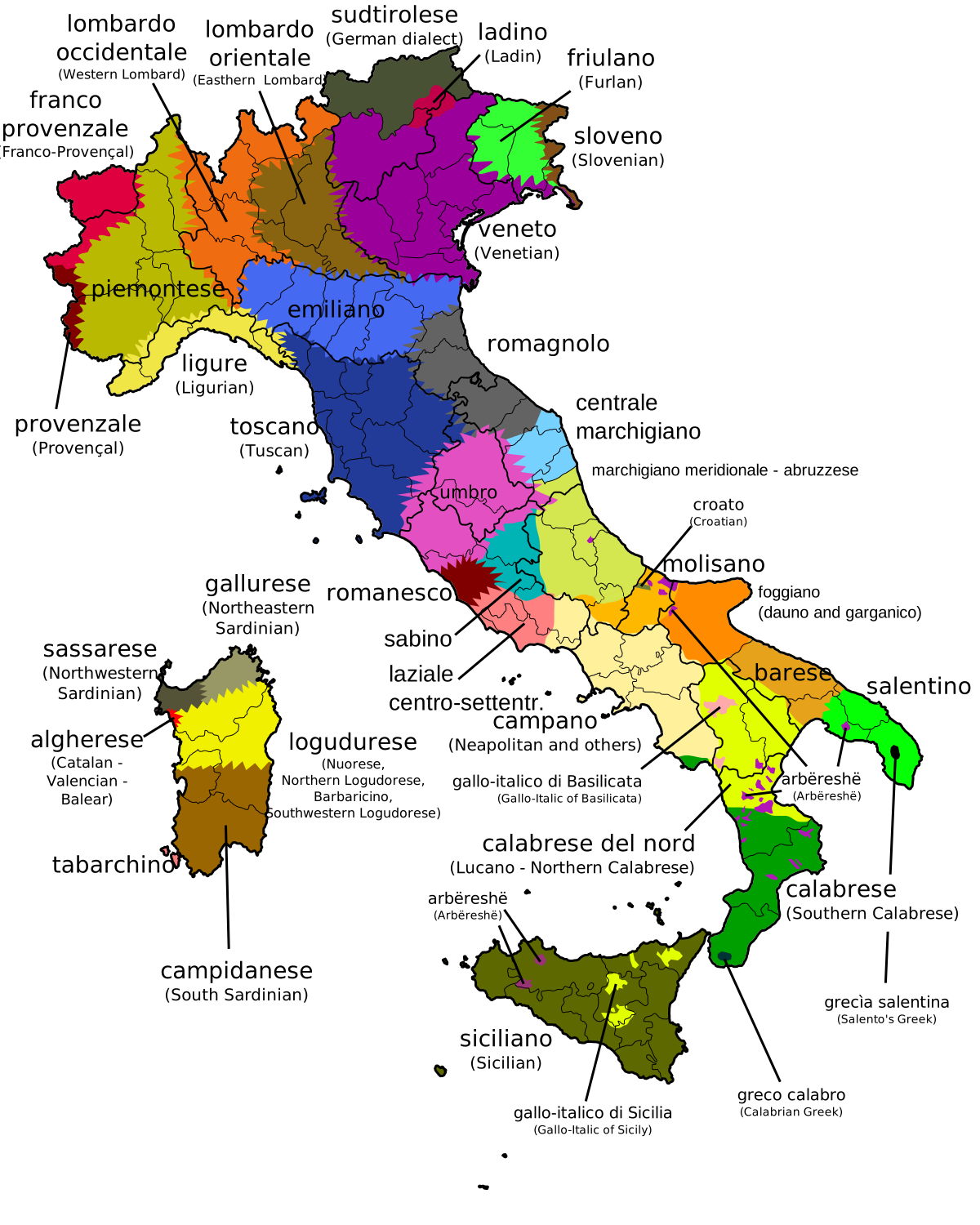
One interesting thing I’ve found about Italians is that they speak less English than their western European neighbours (e.g. Switzerland, Austria, Germany). I’m not sure why there isn’t as much focus on English as in other countries, but it may be because Italy, like Spain, already has multiple dialects within the fairly small country (click on the image to see the full size).

Whatever the reason, and they are often a bit self-deprecating about their abilities (even though I really have had no trouble understanding them). I met one guy (an Italian rapper, no less) who spoke self-proclaimed ‘Macaroni English’, which is apparently quite basic English with a very Italian flair. I think he was being too hard on himself, but I loved the phrase nonetheless.

I think Italians often don’t give themselves enough credit for their language skills. What do you think?

Comments (3)

Stereotypes: can they help?

hand-gesturesI’ve been listening to Italians speak to each other for the last couple of days and I love the ups and downs of the language that are the result of putting the stress on specific syllables in the word. In fact, if you don’t put the stress on the correct part of the word, some people may not understand you at all, even if you do get the actual word right. Most of the time, the stress is on the second to last syllable of the word, even with long words, e.g. cappuccino, panino. There’s also a lot of ‘r’ rolling, which may be hard for some people to get used to. It may be especially difficult for speakers of some Asian languages, which don’t really have ‘r’ sounds in the first place.

I think the best way to make yourself understood is to try to sound as much like a stereotypical Italian as possible. You may think it’s silly, or even offensive, but if you spend some time listening to Italians speak to each other, you will see that they are as expressive as they appear in films and on TV. It may mean making your voice go up and down more often than you’re used to, and speaking with your hands (Italians do this a lot), but it will help. Let your voice and hands go a little, and see if you can pronounce this beautiful language like an enthusiastic native!

Comments

Choosing your unintelligible operating language

ticket-machineI was watching a group of Chinese people operating a train ticket machine in Milan today, and they were struggling a little bit.  Oddly, they kept choosing Italian as the language, when there was also English, German, and a few other languages (although not Chinese).  They managed to operate it in the end*, but I wondered why they didn’t choose English as the operating language.  It’s very possible that they didn’t know much English either (and maybe they did know more Italian then English, although I think it’s unlikely).  But it brought up the question – if all of the languages are mutually unintelligible, do you just pick one at random?

I know that if English wasn’t an available option, I would probably choose Italian, Spanish, or French over, say, German, because I am slightly more familiar with them and they tend to sound a bit more like English.  But if the machine gave me scripts I couldn’t read (say, Russian, Thai, Japanese), what would I do?

The Chinese tourists had the destination stored on their mobile phone, which was a good idea.  It’s always good to have something to compare the options with.  If I was going somewhere without a Romanised script, I’d probably copy and paste to my phone or iPod too.

Have you been in a situation like this?  What did you do?

*The machine wasn’t that difficult to work out, but the delay made me miss my train!  Luckily there was another train an hour later, and I could use the extra time to write this blog post.

Comments

Not exit?

I’ll freely admit that I don’t speak much German.  Of course, I can work out a lot of the words’ meanings if they are similar to English, but this can sometimes lead to false friends.  I learned that Ausgang means exit, so when I saw a sign in Vienna that said Notausgang, I didn’t really think much about it.  I just thought it meant that I couldn’t go through that door.  I guess if I had taken a minute, I would have probably guessed that not doesn’t mean the same thing in English and German.

It wasn’t until I was looking at a sign on a train window some time later that I realised that Notausgang meant emergency exit.  I’m a bit relieved that I never had cause to look for a Notausgang before I realised my mistake.

Comments

Hungry in Hungary

Hungarian dinnerI didn’t know much about Hungarian food before I arrived in Budapest - just that there was goulash and sausages to be eaten in large amounts.  On the way from the airport, my friend briefed me on a few words - hello (szia, pronounced a bit like ’see ya’), thank you (köszi), and a few other words which I forgot embarrassingly quickly.

Once we’d arrived at the markets, I learned quickly that paprika is very important in Hungarian cuisine.  You can even buy it in strings as a souvenir.  Sour cream and sausages are also used a lot, which was good news for me.

After a few meals I got a bit more familiar with the Hungarian words for food items, and quickly worked out which ones I liked (which was basically all of them).  Here are a few:

gulyas - goulash, meat stew or soup
kolbász - spicy sausage
gombóc/Knödel - bread or potato dumpling, often boiled
szendvic - sandwich
torta - cake
palacsintak - thin pancakes, like French crepes, served sweet or savoury

Because all of these things were pretty delicious foods, and/or memorable words, I didn’t have much trouble learning them so I could ask for them again.  If only all words had such motivational properties!

Comments

On the road for a little bit

Scooter RallyI’m on holiday this month, and travelling through six different countries (with six different languages) in less than three weeks can be a bit confusing when it comes to speaking*. I’ve talked before about the things I think it’s necessary to learn when travelling to new places, but I’ve come to the conclusion that you really don’t need much besides hello, thank you, and a smile on your face while you point at things. Of course, a bit more than this is useful, but politeness will get you by, especially if the other person speaks a bit of English too.

I guess this post is just to preface the travel/communication related posts coming up, and to make an excuse for my very irregular posting!

*Thankfully a few of them use Euros so at least the money was slightly simpler.

Comments