
Essential Taiwanese Language and Etiquette Guide for Tourists
Making even a small effort to speak the local language in Taiwan can change the tone of…


UK 0330 460 95 64 Ireland 01 574 7871

UK 0330 460 95 64
Ireland 01 574 7871

Making even a small effort to speak the local language in Taiwan can change the tone of…

Travelling through China, a country with a staggering population of over 1.4 billion, presents an unparalleled adventure...

Sean Hopwood, MBA is the founder and President of Day Translations, Day Interpreting, and Day Impact. He…

Are you someone who has only just begun to come to terms with words like “LOL”, “meme”…

A special thanks to our Chinese teacher, Yongtai, for helping us proofread this article. Writing about the…
Have you decided to start learning Chinese? Well done. Learning Mandarin Chinese will allow you to communicate with…
Everybody seems to be saying that you should learn Chinese as it’s “the language of the future”, but why? How can knowing Mandarin help you in your personal and professional life? Well, it can be beneficial in a lot more ways than you think. Explore some of the reasons why you should learn Chinese today below!
Mandarin is one of the most spoken languages in the world (its speakers account for almost 15% of the world’s population!), which means that being bilingual offers countless opportunities for you. If you ever go to China, you’ll be able to enjoy your travels to the fullest by speaking at least a little Mandarin.

But learning Chinese is also useful if you live in the USA, the UK, Australia, or virtually anywhere. The Chinese diaspora is huge, which means there are thousands or even millions of Mandarin speakers living everywhere. For example, in the USA alone there are 3.8 million people of Chinese descent (according to the 2010 census). Meanwhile, 430,000 Chinese speakers live in the UK and more than 650,000 of them live in Australia.
Today, China is an economic powerhouse, with a staggering GDP of over £10 trillion in 2020 (and it is expected to grow even more in the years to come). As a result, learning Mandarin Chinese can open countless professional doors for you, whether you are an entrepreneur who would like to do business with China or a professional looking for a better job at a Mandarin-speaking company.
Here are some areas where Mandarin Chinese is an invaluable asset:
If you need help learning Chinese for business, we are here for you! Our professional tutors have years of experience teaching Mandarin to people of all ages and backgrounds. Or, if you prefer to learn the language on your own, you can check out our article about Survival Mandarin for Travellers
Chinese culture has existed for over 5,000 years and is rich in art, music, poetry, festivals, religion, and more Enjoy them on a whole new level by learning the Chinese language! Not only will you be able to participate in festivals like the Chinese New Year but you’ll also be able to appreciate and understand traditions like ancestral veneration.

Plus, if you are proficient in Mandarin, you’ll be able to read novels or listen to songs in their original language. In this way, you can appreciate the author’s exact choice of words and understand even the smallest details that can be lost in translation.
Moving to a new country can be a jarring experience, and even more so if you go to a country as different as China. Contrary to some people’s belief, you won’t just “absorb” the language simply by being there. Instead, you’ll feel lost and frustrated because you don’t understand anything that is happening around you.
This is why studying Mandarin is crucial if you plan to move to China (permanently or temporarily), especially if you consider that very few people speak English fluently: a study carried out by the Telegraph shows that less than 1% of China’s population is conversational in English.
The Chinese language is one of the oldest in the world, with over 6,000 years of history. Its written system uses characters (also called symbols) which represent different words. Experts claim that you need to know at least 2,000–3,000 of them to read a simple text.
The Chinese language is part of the Sino-Tibetan family, also called Trans-Himalayan, which comprises more than 400 languages. The evolution of the language is quite complex and we explain it in detail in this article. The most revolutionary change included the birth of pinyin in the 20th century. This is a system that uses the Western alphabet in an attempt to make the language more understandable and represents the phonetic structure of the Chinese characters.
Right now, the main Chinese varieties spoken today include the following:
Do you want to start learning Chinese as a beginner but you are spooked by the characters, the tones, and a new way of writing? Don’t be! Here we present some tips and strategies so you understand how to learn Chinese as a beginner, even if you don’t know a word in Mandarin. Or if you need further help, our professional tutors can outline a personalised learning programme just for you!
Chinese characters may seem inaccessible, not only because they are complicated to produce, but also because, as a beginner, you probably have no idea how to read and pronounce them. The key to learning Chinese characters, then, is to learn pinyin.
Pinyin is a common system used to romanise the writing system. As an example, these Chinese characters:
are written like this in pinyin:
When and why was pinyin born? Well, back in the 1950s, Chinese scholars realised there were too many Chinese dialects and varieties, and that the language needed to be unified. That’s why they standardised the pronunciation of Chinese symbols by inventing pinyin.
The pinyin system is made up of initials, finals, and a diacritic that marks the tone. Just be aware that words in Chinese are not pronounced in the same way as English. For example, shi is not pronounced like the English word “she” but is closer to “sure”. Find more information on how to learn the Chinese tones and their importance in the section about pronunciation below.
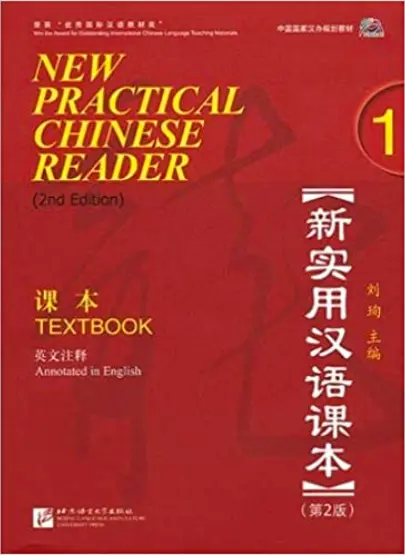
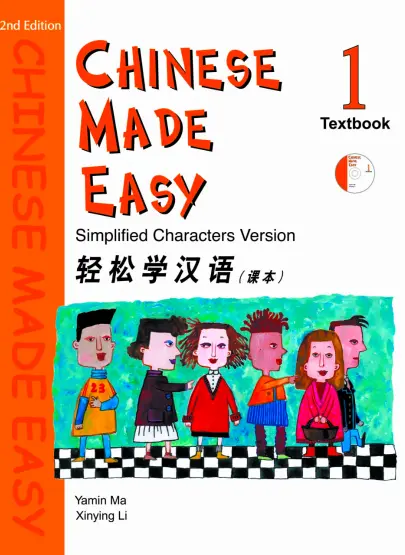
While today there are loads of innovative and creative resources to help you learn Mandarin for free, a good old coursebook always comes in handy. These books have been designed by language professionals and will provide you with an effective framework to start your language journey.
By using a coursebook, you’ll develop your skills in an integrated way. They usually include reading and writing activities with real-life texts as input and listening and speaking activities that your teacher can also use, while working on your pronunciation and teaching you grammar rules and new vocabulary items. Here are some of our top picks when it comes to Chinese textbooks for beginners:

By now, you must know that Mandarin Chinese is a tonal language. But what does this mean? Basically, it means that Chinese speakers convey meaning through tones. The language has fewer sounds than English, and many words are almost the same, but change their meaning depending on the tone you use.
Mandarin Chinese has four different tones you need to learn:
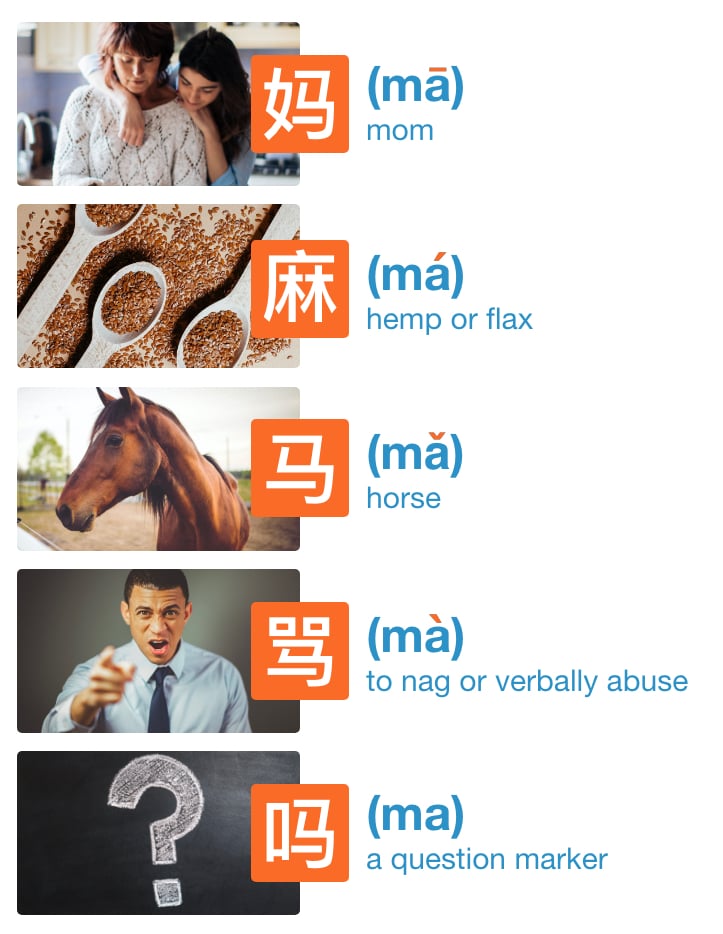
For example, the word “ma” has 4 different meanings, depending on the tone you use. Take a look at the following infographic for more information on how to learn and use Chinese tones!
| Pinyin | Chinese Character | Meaning |
|---|---|---|
| mā | 媽 (trad) / 妈 (simp) | mother |
| má | 麻 | hemp |
| mǎ | 馬 / 马 | horse |
| mà | 罵 / 骂 | scold |
As you can see, if you don’t use the Mandarin tones properly, people are not likely to understand what you are saying. It takes a lot of practice, time, and input to master the tones, but it’s not impossible!
And it’s even easier if you practise in a safe environment with a professional tutor who can point out your strengths and weaknesses. Contact us today and we will pair you up with the perfect teacher for your needs so you can learn Mandarin Chinese right away! Or sign up for a free lesson to have a taste of our online Mandarin classes.
Learning Chinese symbols can be hard, especially if you are not very proficient with calligraphy, but it’s not impossible. While sheer memorisation can work for some, there are other strategies you can adopt to efficiently acquire the Chinese alphabet (which has more than 80,000 characters!).
Luckily, you’ll need only 2,500–3,000 for basic literacy. Take a look at the following strategies and tips on how to learn the Chinese writing system:
If you need more help, get in touch with us to be connected with a professional tutor!
Learning a language entails not only knowing a set of grammar rules or hundreds of words and expressions, but it also involves learning to respect the culture, customs, and traditions of the people who speak it.
China has a unique, ancient culture with over 5,000 years of history that differs widely from the Western one. For example, they don’t even have the same calendar, which is based on the moon and the Chinese zodiac animals.
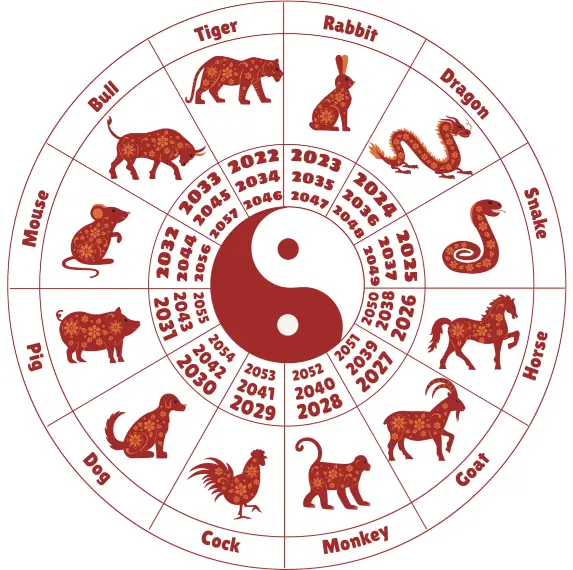
While this is not an exhaustive list, here we present some elements of the Chinese culture you need to understand to be able to speak the language fluently and understand what others are truly saying.
In the USA, the UK, Australia, and almost the whole of the Western world, we use the Gregorian Calendar, which starts on 1 January and ends on 31 December. Instead, the Chinese New Year can fall on any date between January 22 and February 19.
The Chinese culture loves festivities and has dozens of important dates to commemorate. For example, the Chinese New Year is celebrated over two weeks with spectacular parades, fireworks, and food stalls that fill the streets.
Another popular holiday is Tomb-Sweeping Day, at the beginning of April. During this date, Chinese families reunite and travel to their ancestors’ gravesites to honour them by bringing food and sweeping their tombs. Other important dates to consider include:
In China, age and hierarchy should be treated with respect and deference. Elders and ancestors are honoured, and many generations usually live under the same roof, unlike British culture, which tends to foster greater independence. Plus, the Chinese are known for being a lot more direct than people living in the Western world. While talking about your age, income, or marital status can be intrusive and too personal for us, it’s very common to discuss these topics in China.
While the Western world may take freedom of speech and access to information for granted, the situation is quite different in China. The government controls the media and the internet and decides what citizens can access or not. For example, Facebook is not available in China and many famous newspapers are completely blocked.
Hand gestures and facial expressions are important everywhere, but knowing how the Chinese make use of these paralinguistic elements is crucial if you plan to communicate with them successfully. Soon, you’ll discover that certain gestures that are natural for you may be unknown or even disrespectful in China.

For example, you may offend someone by pointing at them with your index finger. Instead, the appropriate way to do so is to gesture with your whole palm facing upwards. If you’d like to know more, you can read our article with the top 10 Chinese gestures you should know for effective communication so you learn Chinese in the most effective way possible.
Now that you have decided to start learning Chinese, you face another choice: whether or not to sign up for Mandarin lessons with a teacher. You can also choose between learning with friends and family, people from different parts of the world, or alone with your teacher, online or face to face.
While it can be tempting to learn Chinese on your own, it can be tough to do so if you are only a beginner. Should you start with the writing system or with the tones? How do you know whether you are saying horse or mother when saying ma? How can you use Chinese music to increase your listening comprehension?
Well, all these issues can be addressed by booking lessons with an experienced Mandarin tutor. Professional teachers can point you in the right direction, pinpointing your strengths and weaknesses and answering all of your questions during the lesson. Plus, there are other benefits of studying Mandarin with a teacher, such as:
And the best part is that you don’t need to have a large budget to start studying Mandarin today. We offer affordable online open group courses where you’ll get to meet like-minded individuals who love languages as much as you do! Contact us and learn more about Language Trainers Connect.
If you are looking to learn Chinese for free, there are several apps that can help you in your efforts. Remember, practice makes perfect. If you only have 15 minutes to spend on learning Chinese every day, make them count! And be consistent so your effort pays off.
Here are some of our top picks when it comes to resources to learn Chinese:
Chinese has a reputation for being hard to learn as an English speaker, and those who say so may be right. As we already mentioned, Mandarin has many elements that are very different from those of English, such as the writing system, tone usage and vocabulary
However, there are many other aspects of the language that are very easy to acquire! With motivation, effort, and perseverance, you’ll be fluent in no time. For example:
Mandarin Chinese is easier than you think. Especially if you have a native-speaking instructor to guide you on your language journey. Give it a try! Click here and sign up for a FREE trial Chinese lesson at a time that suits you!
If you are travelling to China soon and have never uttered a word of Mandarin before, you should seriously consider taking a short course for travellers to acquire the essentials. Plus, you can use the following survival phrases, such as greetings or ask for help, to try and survive in China as a tourist!
| Phrases (EN) | CHINESE |
|---|---|
| Hello / Hi | 您好/你好 |
| How are you? / How are you doing? | 您好吗?/你好吗? |
| Good morning/afternoon/night | 早上好/下午好/晚上好 |
| Thank you! Thanks! (You're welcome) | 谢谢您! 谢谢!(不客气) |
| I appreciate it. | 我十分感谢。 |
| Apologies | 非常抱歉(正式) |
| I’m sorry / I’m very sorry | 抱歉/我很抱歉 |
| Where is... the bathroom/the kitchen? | 洗手间在哪里?/厨房在哪里? |
| Can you help me with... my luggage/my phone? | 您能帮忙….我的行李/我的电话吗? |
| There is a problem with/ I have a problem with... | ….有点问题/我的….有点问题 |
| How can I get to... the museum/ the hotel/ the restaurant? | 我怎么才能到….博物馆/酒店/餐馆? |
| Do you know where...? | 您知道….吗? |
| Could you tell me...? | 您能告诉我….吗? |
| I'd like the tuna salad/a sandwich, please | 我想要一份金枪鱼沙拉/三明治,谢谢。 |
| I'll have the steak/french fries, please | 我想要一份牛排/炸薯条,谢谢。 |
| Nothing for me, thanks. | 我不需要,谢谢。 |
| Sorry, can you repeat? | 麻烦您能再说一遍吗? |
| I don't understand. Can you say that again? | 我没听明白。您能再说一遍吗? |
| What do you mean by...? | 您的意思是….? |
| Would you like to... go to the cinema? | 您想要….去看电影吗? |
| Do you want to...? | 您想要…吗? |
| Yes, thank you | 是的,谢谢您。 |
| Sure! | 当然! |
| Let's do it. | 一起去吧。 |
| No, thank you | 不,谢谢您。 |
| I’d love to, but I’m busy right now. | 我想去,但是我现在很忙。 |
| Thank you, I have other plans. | 谢谢您,我有别的安排。 |
| How much is this? | 这个多少钱? |
| How much does this cost? | 这个多少钱? |
More resources that will help you be fluent in Mandarin:
Are you ready to get started with learning Mandarin Chinese? Reach out to us at Language Trainers and we will prepare the most interactive and communicative programme for you to learn this fascinating Asian language effortlessly! You just need to choose whether you want to study Mandarin alone or in a group, face to face or online. Learn with us anytime, anywhere!