
Nepali Phrases for Tourists: Essential Words and Expressions for Visiting Nepal
 Posted by
 Nepal has a way of turning small gestures into memorable moments. Press your palms together and say Namaste [Hello / Greetings] when you meet a guide, enter a family-run lodge, or greet someone near a temple, and the exchange immediately feels warmer. Say Dhanyabaad [Thank you] when tea appears after a long walk or a shopkeeper helps you with directions, and you are doing more than being polite. You are showing that you have arrived with curiosity, respect, and a willingness to meet Nepal through its own language.
This Nepali guide for travellers will cover the phrases tourists are most likely to need in Nepal, including greetings, polite expressions, food and drink phrases, directions, shopping, trekking, homestays, emergencies, and everyday conversations. It will also explain how Nepali works alongside English and local languages, what pronunciation details can help you sound clearer, which cultural rules matter most, and how personalised Nepali lessons can help you prepare before your trip.
→Sign Up Now: Free Trial Nepali Lesson With a Native Teacher!←
What Language Is Spoken in Nepal?
Nepali is the official language of Nepal and the main shared language used across the country. It is the language travellers are most likely to hear in government offices, schools, transport situations, hotels, shops, trekking lodges, and everyday public life. For tourists, Nepali is usually the most useful local language to learn before visiting, because it can help in many different regions and travel situations.
However, Nepal is not linguistically simple. The country is home to many ethnic communities, each with its own history, traditions, and often its own language. Depending on where you travel, you may hear Newari, Tamang, Gurung, Sherpa, Tharu, Maithili, Bhojpuri, or many other languages alongside Nepali. This diversity is part of what makes Nepal culturally rich, but it also means travellers should avoid thinking of the country as one single language community.
That said, learning Nepali is still the best starting point for most visitors. A phrase such as Namaste will be understood almost everywhere, while useful words like paani [water], khana [food / meal], bato [road / path], and dhanyabaad [thank you] can help in practical situations. Even when someone’s first language is not Nepali, these phrases often work as a respectful bridge.
For tourists, the goal is not to master Nepal’s full linguistic diversity before arriving. The goal is to understand that Nepali is widely useful, while also recognising that Nepal contains many local languages and identities. That awareness helps you travel with more respect, especially in villages, homestays, and trekking regions where language is closely tied to community and place.
Is Nepali the Same as Nepalese?
Nepali and Nepalese are related words, but they are not exactly the same. Nepali is the name of the national language of Nepal. Nepalese usually refers to people from Nepal, nationality, culture, or things connected to the country. For example, you can say “Nepali language” when talking about the language, and “Nepalese culture” or “Nepalese people” when talking more generally about the country and its people.
This distinction matters because tourists sometimes use “Nepalese” as the name of the language. People will usually understand what you mean, but Nepali is the more accurate term for the language itself. If you are asking about phrases, pronunciation, or lessons, “Nepali” is the word to use.
It is also important not to confuse Nepali with Newari, also known as Nepal Bhasa. Newari is a separate language associated with the Newar community of the Kathmandu Valley. It is not a dialect of Nepali. It has its own history, cultural role, and connection to historic cities such as Kathmandu, Patan, and Bhaktapur.
For most travellers, Nepali will be the practical language to learn first. Still, knowing one local greeting can be a meaningful cultural gesture in the right place. In Newar heritage areas, a phrase such as Jwajalapaa [Hello] may be appreciated because it shows that you recognise the local culture of the Kathmandu Valley, not only the national language.
Where Is Nepali Spoken?
Nepali is spoken throughout Nepal and is especially useful in the places most tourists visit: Kathmandu, Pokhara, trekking routes, hotels, restaurants, bus stations, markets, temples, and homestays. It is the language that helps connect people across regions, even in a country where many communities also speak their own local languages.
For travellers, Nepali becomes especially useful outside the most international tourist areas. In places like Thamel or Lakeside Pokhara, many hotel staff, guides, restaurant workers, and shopkeepers may speak some English. But in smaller villages, rural homestays, local buses, family-run tea houses, and remote trekking areas, English may be more limited. In those situations, even a few Nepali phrases can make communication smoother.
Nepali is also spoken outside Nepal. Nepali-speaking communities can be found in parts of Northeast India, including areas with historic and cultural links to Nepal, as well as in Bhutan and among Nepali communities abroad. Migration has also taken Nepali into many larger cities around the world.
However, this guide is mainly written for people travelling in Nepal. That is where phrases such as Khana cha? [Is there food?], Yo bato ho? [Is this the way?], Mitho cha [It is delicious], and Pheri bhetaula [See you again] can become part of real travel moments, from a mountain lodge meal to a conversation with a guide or host family.
Why Should Tourists Learn Nepali Before Visiting Nepal?
Tourists should learn a few Nepali phrases before visiting Nepal because language is one of the simplest ways to show respect. Many travellers arrive knowing that Nepal is beautiful, spiritual, and welcoming, but language helps turn that admiration into real connection. Saying Namaste with your palms together, or Dhanyabaad after someone brings tea, gives directions, or helps with a bag, shows that you are not treating the interaction as purely transactional.
These small phrases matter in many travel situations. Guides, porters, lodge owners, homestay families, drivers, shopkeepers, monks, restaurant staff, and villagers often respond warmly when visitors try Nepali. The pronunciation does not have to be perfect. The effort itself can soften the exchange and make people more willing to help, teach, or continue the conversation.
Learning Nepali is also useful because Nepalese hospitality often comes with small cultural expectations. In a homestay, someone may offer more food even when you are already full. On a trek, a guide may tell you to walk slowly for safety. In a temple, someone may expect you to remove your shoes, stay calm, or avoid pointing with your feet. Phrases such as Pugyo, dhanyabaad [I am full, thank you], Bistarai bistarai [Slowly, slowly], and Maaf garnus [Sorry / Excuse me] help you respond respectfully.
Nepalese people are often gracious with visitors, and many will forgive small mistakes. Still, mindful travel means trying to understand the place you are in. Learning basic Nepali should go together with calmness, humility, and awareness of local customs. A few words will not make you fluent, but they can help you move through Nepal with more care.
How Do You Greet Someone in Nepali?
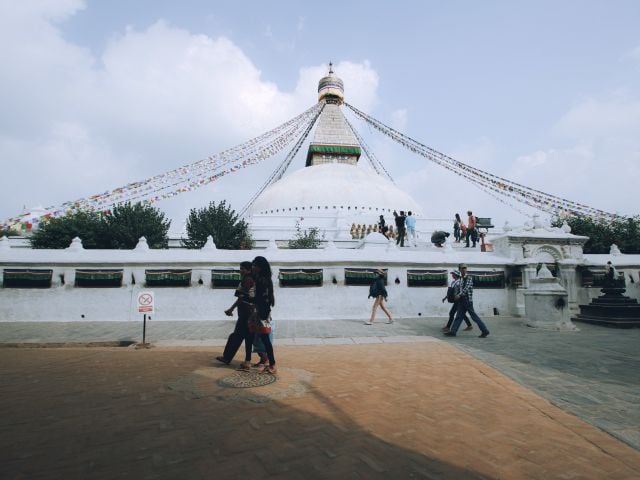
Greeting someone in Nepal is both a phrase and a gesture. Tourists should learn Namaste [Hello / Greetings] before almost any other word, because it works in temples, hotels, trekking lodges, homestays, markets, and village paths. The gesture matters too: press your palms together lightly in front of your chest and give a small nod, especially when greeting elders, hosts, guides, monks, or people in rural communities.
Namaskar [Respectful greeting] is another useful word to know. It can sound slightly more formal or respectful than Namaste, so it may fit well when greeting older people or entering a more traditional setting. The sections below cover how to say hello, how to ask “How are you?”, and how to reply politely in everyday Nepali.
How to Say Hello in Nepali
Namaste
[Hello / Greetings]
This is the most important Nepali greeting for tourists. Use it at any time of day, with almost anyone, and add the palms-together gesture for extra warmth.
Namaskar
[Respectful greeting]
This sounds a little more formal or respectful than Namaste. It is useful with elders, hosts, teachers, or people you want to address with extra politeness.
Subha bihani
[Good morning]
Use this in the morning, especially in hotels, homestays, or trekking lodges when greeting hosts, guides, or staff at breakfast.
Subha din
[Good day]
A polite daytime greeting. It is less essential than Namaste, but useful if you want to vary your greetings.
Subha saanjh
[Good evening]
Use this later in the day when arriving somewhere, greeting a host, or returning to a lodge after a walk.
Subha raatri
[Good night]
Use this when saying good night before going to sleep. It fits naturally in homestays, hotels, and family settings.
How to Ask “How Are You?” in Nepali
Tapai lai kasto cha?
[How are you?]
This is a useful general question when speaking politely to one person. It works well when meeting a host, guide, teacher, or someone you do not know well.
Sanchai hunuhunchha?
[Are you well?]
A respectful way to ask how someone is. It can sound caring and polite, especially with elders or hosts.
Khana khaanu bhayo?
[Have you eaten?]
This can work as a warm social check-in, especially in homestay, family, or village contexts. In Nepal, food is closely connected to care and hospitality, so this question can feel more personal than a simple “How are you?”
Tapai thik hunuhunchha?
[Are you okay?]
Use this when you want to check on someone’s comfort or wellbeing. It can be useful with a trekking companion, guide, host, or driver.
How to Reply Politely in Nepali
Malai sanchai cha
[I am fine]
A polite and useful answer when someone asks how you are. It is a good phrase to learn early.
Malai thik cha
[I am okay]
Use this to say you are fine, comfortable, or managing well. It is practical in hotels, homestays, and trekking situations.
Thik cha
[Okay / Fine]
One of the most useful everyday Nepali phrases. Use it to agree, confirm something, or say that a situation is fine.
Hajur
[Yes / respectful response / I am listening]
A very useful polite response. It can mean “yes,” but it also works as a respectful way to show that you are listening.
Pheri bhetaula
[See you again]
A warm way to say goodbye. It feels more personal than simply leaving with a wave, especially after a homestay meal, a guided visit, or a friendly conversation.
How Do You Use Polite Nepali Phrases?
Politeness in Nepal depends on words, tone, gestures, and respect for age and status. Dhanyabaad [Thank you] is essential when someone serves tea, gives directions, carries luggage, explains a trail, or welcomes you into a home. Maaf garnus [Sorry / Excuse me] is just as useful when you need to pass someone, get attention politely, or apologise for a small mistake.
Gestures also matter. When giving or receiving something, such as money, food, tea, a ticket, or a gift, use your right hand or both hands whenever possible. This small habit shows respect and helps your words feel sincere. The sections below cover how to say thank you, how to say please, sorry, and excuse me, and which polite Nepali phrases locals are likely to appreciate.
How to Say Thank You in Nepali
Dhanyabaad
[Thank you]
The essential Nepali thank-you phrase. Use it often, especially when someone helps you, serves food, or gives directions.
Dherai dhanyabaad
[Thank you very much]
Use this when someone has made a special effort for you, such as helping with luggage, preparing a meal, arranging transport, or explaining something patiently.
Hajur
[Yes / respectful acknowledgement]
This is not a direct translation of “thank you,” but it is useful in polite exchanges. Use it to show respect, attention, or agreement.
Thik cha
[It is okay / It is fine]
Use this to accept, confirm, or reassure someone. It is useful when a host asks whether the room, food, or arrangement is fine.
How to Say Please, Sorry, and Excuse Me in Nepali
Kripaya
[Please]
A useful polite word when making requests. Tourists may use it when asking for help, food, directions, or information.
Maaf garnus
[Sorry / Excuse me]
Use this when apologising, moving past someone, interrupting politely, or getting someone’s attention.
Bistarai bhannus
[Please say it slowly]
Very useful when someone speaks too quickly. It is especially helpful in transport, trekking, market, and homestay situations.
Pheri bhannus
[Please say it again]
Use this when you missed a word, price, place name, or instruction.
Lekhidinus
[Please write it down]
Helpful for hotel names, phone numbers, addresses, trail stops, bus information, or anything you may need to show another person later.
Polite Nepali Phrases Locals Will Appreciate
Ali ali Nepali bolchhu
[I speak a little Nepali]
A humble phrase that tells people you are trying, but still learning. It can make the other person more patient and encouraging.
Ma Nepali sikdai chhu
[I am learning Nepali]
Use this when someone smiles at your attempt or asks how much Nepali you know. It often invites friendly corrections or new words.
Tapai sanga bhetera khushi lagyo
[Nice to meet you]
A warm phrase for introductions. It is especially useful with hosts, guides, teachers, or people you spend time with during your trip.
Tapai ko ghar raamro cha
[Your home is beautiful]
A thoughtful compliment in a homestay. Use it when you arrive or after your host shows you around.
Yo thau raamro cha
[This place is beautiful]
Useful when admiring a village, mountain view, temple area, farm, or homestay location. It shows that you value the place, not only the service you are receiving.
How Do You Ask for Directions in Nepali?
Asking for directions in Nepal can involve streets, landmarks, temples, bus stops, trekking trails, and local references that do not always appear clearly on maps. A phrase pattern like ___ kahaa cha? [Where is ___?] is useful because you can add the place you need, while Yo bato ho? [Is this the way?] can help you confirm that you are following the right road, path, or trail.
This matters in cities, villages, and trekking regions. In Kathmandu or Pokhara, you may need help finding a bus stop, hotel, temple, or taxi stand. On a trek, you may need to confirm a trail with your guide, a porter, a lodge owner, or someone from the village. Public transport and mountain routes can depend on local knowledge, so the phrases below will help you ask clearly and check what you understood.
Nepali Words for Places, Streets, and Transport
bato
[road / way / path]
A very useful word for both city directions and trekking routes. It can refer to a street, road, path, or trail depending on context.
bus station
[bus station]
This English phrase is widely useful in tourist and transport situations. You may also hear it mixed into Nepali sentences.
taxi
[taxi]
A practical transport word in cities and tourist towns. It is easy to use when asking for a ride or looking for a taxi stand.
paani
[water]
Essential for travel and trekking. You may need it in restaurants, tea houses, shops, or mountain lodges.
shauchalaya
[toilet / bathroom]
A useful word for a bathroom or toilet, especially outside very touristy places.
hotel
[hotel]
Common and easy to recognise. It can help when asking for accommodation or directions back to where you are staying.
mandir
[temple]
Useful in towns, villages, and heritage areas, where temples are often used as landmarks.
gaun
[village]
A helpful word for rural travel and trekking. You may hear it when people describe where they live or where the trail leads.
Useful Nepali Travel Phrases for Buses, Taxis, and Walking Around
___ kahaa cha?
[Where is ___?]
Use this pattern with the place you need. For example, shauchalaya kahaa cha? means “Where is the bathroom?”
Bus station kata ho?
[Where is the bus station?]
Useful in cities, towns, and transit areas. Use it when you need help finding the right place to wait.
Yo bus ___ janchha?
[Does this bus go to ___?]
A practical question before getting on a bus. Add your destination in the blank.
Dai, malai taxi chahincha.
[Brother, I need a taxi.]
Use Dai politely when speaking to an older man or male driver. This can sound warmer than asking too directly.
Yaha roknus.
[Stop here.]
Useful in taxis, local buses, or shared transport when you need to get off.
Sidha janus.
[Go straight.]
A useful phrase to recognise when someone gives directions.
Daya.
[Right.]
Helpful for understanding directions. You may also hear daya haat, literally “right hand.”
Baya.
[Left.]
Useful together with daya when following walking directions, road instructions, or trekking paths.
How Do You Order Food and Drinks in Nepali?
Food is central to hospitality in Nepal, especially in homestays, tea houses, trekking lodges, and family settings. A simple Mitho cha [It is delicious] can completely change the mood at the table because it tells the person who cooked that you appreciate their effort. When you have eaten enough, Pugyo, dhanyabaad [I am full, thank you] helps you refuse more food gently instead of simply shaking your head.
This is especially useful because hosts may offer second or third servings as a sign of care. In trekking lodges, food also becomes part of daily routine: tea before walking, dal bhat after a long day, hot water at altitude, and snacks during breaks. The phrases below cover basic food words, useful restaurant and homestay phrases, and simple ways to compliment a meal.
How to Talk About Food in Nepali
khana
[food / meal]
One of the most important food words to learn. You will hear it in homes, lodges, and restaurants.
paani
[water]
Essential for every traveller, especially on treks. Add tato before it to ask for hot water.
chiya
[tea]
Tea is part of daily life in Nepal. You will hear this word often in homes, lodges, and roadside stops.
dudh chiya
[milk tea]
Useful if you want tea with milk. This is common in many parts of Nepal.
masala chiya
[spiced milk tea]
A warm and flavourful tea with spices. It is especially welcome in cold mountain areas.
momo
[dumplings]
A must-know food word for travellers. Momos are popular across Nepal and easy to find in many towns.
dal bhat
[lentils and rice]
A staple meal in Nepal and very common on trekking routes. It is filling, practical, and often served with vegetables or pickles.
masu
[meat]
Useful when asking whether a dish contains meat or when checking food options.
Useful Nepali Food Phrases for Restaurants and Homestays
Khana cha?
[Is there food?]
A practical question in lodges, small restaurants, or rural areas where menus may be limited.
Malai bhok lagyo.
[I am hungry.]
Useful with guides, hosts, or lodge staff, especially during trekking days.
Tato paani dinus.
[Please give me hot water.]
Very useful on treks, in tea houses, and in colder regions. Hot water may also be important for safety and comfort at altitude.
Ma shakahaari ho.
[I am vegetarian.]
An important phrase for dietary needs. Use it before ordering or when your host offers food.
Masu cha?
[Is there meat?]
Useful when checking what a dish contains.
Piro cha?
[Is it spicy?]
A helpful phrase before trying unfamiliar food, especially pickles, sauces, or curries.
Bill dinus.
[Please give me the bill.]
Useful in restaurants and cafés. Add a polite tone to make it sound natural.
How to Say Something Is Delicious in Nepali
Mitho cha.
[It is delicious.]
One of the best food phrases for tourists. Say it while eating to show real appreciation.
Dherai mitho cha.
[It is very delicious.]
A stronger compliment. Use it when you really enjoy the meal.
Mitho thiyo.
[It was delicious.]
Use this after finishing a meal. It is a thoughtful way to thank the person who cooked.
Alikati matra dinus.
[Just a little, please.]
Useful when your host offers more food and you want to accept politely without taking too much.
Pugyo, dhanyabaad.
[I am full, thank you.]
A respectful way to stop more servings. It is clearer and warmer than refusing silently.
How Do You Shop in Nepali?
Nepali shopping phrases are useful in markets, souvenir shops, trekking towns, small stores, and local stalls. Yo kati ho? [How much is this?] is one of the first questions tourists should learn, while Ali sasto huncha? [Can it be cheaper?] can help in places where bargaining is expected.
The important point is to stay respectful. Bargaining can happen in some markets, but it should not feel aggressive or dismissive. A small amount may matter more to a local seller than to a traveller, so keep the exchange friendly. Begin with Namaste, ask the price clearly, and use Dhanyabaad even when you decide not to buy. The sections below cover price questions, numbers, and useful phrases for shops and markets.
How to Ask “How Much Is This?” in Nepali
Yo kati ho?
[How much is this?]
A simple and very useful shopping phrase. Use it while pointing politely to the item.
Kati rupiya ho?
[How many rupees is it?]
Useful when you want to ask the price in Nepali rupees.
Yesko kati parchha?
[How much does this cost?]
Another common way to ask the price. It is useful in markets and shops.
Ali sasto huncha?
[Can it be cheaper?]
Use this gently when bargaining is appropriate. A smile and calm tone matter.
Ati mahango cha.
[It is too expensive.]
Useful when the price is higher than expected. Keep it light so the exchange stays friendly.
Nepali Numbers and Simple Buying Phrases
ek
[one]
Useful for buying one item, one ticket, or one portion.
dui
[two]
Helpful when ordering food, drinks, or small items.
teen
[three]
A practical number for shopping and group travel.
chaar
[four]
Useful for tickets, portions, or items.
paanch
[five]
A helpful number for simple purchases.
das
[ten]
Useful when understanding prices, quantities, or travel times.
saya
[hundred]
Important for prices in Nepali rupees.
Malai yo man parcha.
[I like this.]
A friendly phrase when looking at clothing, crafts, souvenirs, or local products.
Friendly Nepali Phrases for Markets and Small Shops
Namaste.
[Hello.]
Use this before asking for a price or looking around. It makes the interaction warmer.
Dhanyabaad.
[Thank you.]
Use it after receiving help, change, directions, or information.
Ma herdai matra ho.
[I am just looking.]
Useful when you want to browse without pressure.
Arko colour cha?
[Do you have another colour?]
Helpful when shopping for clothes, scarves, bags, or souvenirs.
Thulo size cha?
[Do you have a bigger size?]
Useful for clothing, shoes, trekking gear, or accessories.
Size thik cha.
[The size is fine.]
Use this when trying something on or confirming that an item fits.
How Do You Socialise with Locals in Nepali?
Socialising in Nepal often begins gently. People may ask where you are from, whether you have eaten, how long you are staying, or where you are going next. A phrase like Tapaaiko naam ke ho? [What is your name?] helps you move beyond smiling and nodding, while Mero naam ___ ho [My name is ___] lets you answer in a way that feels personal rather than distant.
Nepali conversation also carries a strong sense of respect and family warmth. Address terms such as Dai [Older brother], Didi [Older sister], Aama [Mother / older woman], and Buwa [Father / older man] are not limited to your own relatives. Used appropriately, they can make an exchange feel softer and more human, especially with hosts, shopkeepers, guides, drivers, and older people in villages. The sections below cover introductions, everyday conversation phrases, and respectful ways to address people in Nepali.
How to Introduce Yourself in Nepali
Tapaaiko naam ke ho?
[What is your name?]
Use this when you first meet someone and want to begin a real conversation. It is especially useful with hosts, guides, drivers, and people you may see more than once during your trip.
Mero naam ___ ho.
[My name is ___.]
Use this after someone tells you their name, or when introducing yourself first. Add your name in the blank.
Ma ___ bata aaeko ho.
[I come from ___.]
This is useful because people in Nepal will often ask where you are from. Add your country or city in the blank.
Tapai sanga bhetera khushi lagyo.
[Nice to meet you.]
A warm phrase for introductions. It sounds thoughtful when meeting a host family, guide, teacher, or someone who has helped you.
Tapai haru kaha bata ho?
[Where are you from?]
Use this when speaking to more than one person. It can open conversations with families, guides, shopkeepers, or people you meet on a trek.
Friendly Nepali Phrases for Everyday Conversations
Thik cha.
[Okay / Fine.]
One of the most useful phrases in daily Nepali. Use it to agree, confirm, or say that something is fine.
Hajur.
[Yes / Respectful response.]
A polite word that shows you are listening. It can sound warmer and more respectful than a simple “yes.”
Ramro cha.
[It is good / nice.]
Use this when reacting to a place, meal, room, view, plan, or suggestion. It is simple, positive, and very practical.
Yo ke ho?
[What is this?]
A useful phrase when you see unfamiliar food, objects, rituals, decorations, or tools. It often invites people to explain something about local life.
Yo thau raamro cha.
[This place is beautiful.]
Use this when admiring a village, mountain view, temple area, homestay, garden, or viewpoint. It shows that you are noticing the place, not only passing through it.
Pheri bhetaula.
[See you again.]
A warmer goodbye than simply leaving. It fits well after a homestay, a guided walk, a meal, or a friendly exchange.
How to Address People Respectfully in Nepali
Dai
[Older brother.]
Use this for an older man in a friendly, respectful way. Travellers often use it with drivers, guides, shopkeepers, and men they meet casually.
Didi
[Older sister.]
Use this for an older woman in a warm, respectful way. It can make an everyday exchange feel more personal.
Bhai
[Younger brother.]
Use this for a younger man or boy, but be careful with tone. It should sound friendly, not dismissive.
Bahini
[Younger sister.]
Use this for a younger woman or girl in a kind, respectful way.
Aama
[Mother / older woman.]
Use this with older women when the setting feels warm and informal, especially in village or homestay contexts. It can feel very affectionate.
Buwa
[Father / older man.]
Use this for an older man in a respectful, family-like way, especially in traditional or rural settings.
Sathi
[Friend.]
Use this with people closer to your age or in relaxed situations. It is friendly, but not as respectful as Dai, Didi, Aama, or Buwa.
How Do You Use Nepali Phrases While Trekking?
Nepali trekking phrases matter because the higher or more remote you go, the more travel depends on simple, clear human communication. In popular areas, many guides and lodge owners speak English, but on smaller trails, in family-run tea houses, or during tiring walking days, a few Nepali words can make things easier. Bistarai bistarai [Slowly, slowly] is not only a language phrase; it also reflects good trekking wisdom. Walking slowly helps you pace yourself, especially at altitude. Thakai lagyo [I am tired] is just as practical when you need your guide or porter to understand that you need a break.
On the trail, Nepali is often connected to safety, rhythm, and daily routine. You hear it when guides say it is time to move, when lodge owners ask what you want to eat, when someone points out the right path, or when a porter checks whether you are okay. The sections below cover essential trekking phrases, trail vocabulary, and useful expressions for tea houses and mountain lodges.
Essential Nepali Trekking Phrases
Jam jam.
[Let’s go.]
Guides often use this when it is time to start walking again after tea, lunch, rest, or a checkpoint.
Bistarai bistarai.
[Slowly, slowly.]
A very useful trekking phrase. It reminds you to keep a steady pace, especially on uphill trails or at altitude.
Thakai lagyo.
[I am tired.]
Use this when you need a short rest. It is better to say it clearly than to push too hard in silence.
Malai aram garna chahanchhu.
[I need to rest.]
A more complete phrase than Thakai lagyo. Use it when you need to stop for a little while.
Malai guide chahincha.
[I need a guide.]
Useful when arranging a trek, asking for help, or making sure you have local support.
Yaha bato kata ho?
[Where is the trail here?]
Useful when the path is unclear, especially near junctions, villages, fields, or forest sections.
Nepali Words for Trails, Rest, and Altitude
mathi
[upwards.]
Useful when understanding whether the trail goes up. You may hear this often in mountain areas.
tala
[downwards.]
The opposite of mathi. Helpful when someone explains whether to descend or take the lower path.
bato
[path / trail.]
One of the most useful words for trekking and directions. It can mean road, way, path, or trail depending on the setting.
aram
[rest.]
Useful when talking about stopping, recovering, or taking a break.
paani
[water.]
Essential on any trek. You will need this word in lodges, shops, tea houses, and rest stops.
khaja
[snack.]
A useful word for light food between meals, especially during long walking days.
network cha?
[Is there mobile network?]
Practical in remote areas, where phone signal may change from village to village.
Useful Phrases for Tea Houses and Mountain Lodges
Kotha cha?
[Is there a room?]
Useful when arriving at a lodge or tea house and asking about accommodation.
Tato paani cha?
[Is there hot water?]
Very useful in cold mountain areas. Hot water can mean drinking water, washing water, or shower water depending on context, so clarify when needed.
Wi-Fi cha?
[Is there Wi-Fi?]
A practical phrase in trekking lodges. Do not assume it will be free, fast, or available everywhere.
Ek raat ko lagi ho.
[It is for one night.]
Useful when booking a room or explaining how long you plan to stay.
Khana cha?
[Is there food?]
A simple and important phrase after a long walk. It works in lodges, small restaurants, and tea houses.
Pugyo, dhanyabaad.
[I am full, thank you.]
Very useful when a host or lodge owner offers more food. It lets you refuse warmly and respectfully.
How Do You Ask for Help in Nepali?
Asking for help in Nepali can mean many different things: clarifying a sentence, checking a direction, finding a bathroom, asking for medical help, or explaining that something has been lost. Maile bujhina [I didn’t understand] is one of the most useful phrases for everyday confusion, while Tapaiko sahayog chahinchha [I need your help] makes the request clearer when you need assistance.
In Nepal, people will often try to help a traveller who asks calmly and respectfully. Still, in an emergency, the priority is being understood, not using perfect Nepali. Use English, gestures, a map, your phone, or any shared language when that is clearer. Nepali phrases are helpful tools, but safety comes first. The sections below cover how to say you do not understand, how to ask someone to slow down, and essential emergency phrases for tourists.
How to Say “I Don’t Understand” in Nepali
Maile bujhina.
[I didn’t understand.]
A useful phrase when you missed the meaning of what someone said. Use it with a polite tone.
Bujhna sakina.
[I couldn’t understand.]
Similar to Maile bujhina, but it can sound a little more complete when explaining confusion.
Ma Nepali bujhdina.
[I do not understand Nepali.]
Use this when someone is speaking Nepali and you need them to slow down, repeat, or switch languages.
Ali ali Nepali bolchhu.
[I speak a little Nepali.]
A humble phrase that tells people you are trying but still learning.
Pheri bhannus.
[Please say it again.]
Useful when you missed a price, place name, direction, instruction, or question.
How to Ask Someone to Speak Slowly
Bistarai bhannus.
[Please speak slowly.]
One of the most helpful phrases for tourists. Use it when someone is speaking too quickly.
Bistarai bistarai.
[Slowly, slowly.]
Useful on treks and in conversation. It can refer to walking pace or the need to slow down.
Pheri bhannus.
[Please say it again.]
Use this when you need repetition rather than a slower explanation.
Lekhidinus.
[Please write it down.]
Very useful for hotel names, bus information, phone numbers, directions, medicine names, or prices.
English bolnuhunchha?
[Do you speak English?]
Helpful in hotels, hospitals, transport situations, tourist offices, or emergencies. Ask politely and be ready for a partial answer.
Emergency Nepali Phrases for Tourists
Madat garnus!
[Help!]
A direct emergency phrase. Use it loudly and clearly when you need immediate help.
Chor!
[Thief!]
Useful to recognise and use in theft situations.
Ma haraye.
[I am lost.]
Important if you lose your way in a city, village, trekking area, or crowded place.
Police station kahaan ho?
[Where is the police station?]
Useful after a theft, safety issue, or lost-document situation.
Ambulance bolau.
[Call an ambulance.]
A serious emergency phrase. Use gestures or English as well if needed.
Malai aspatal jaanu cha.
[I need to go to the hospital.]
Essential for medical situations. You may also show the phrase on your phone.
Ma aswastha chhu.
[I am not feeling well.]
Useful when speaking to a guide, host, lodge owner, driver, or medical worker.
Mobile harayo.
[My phone is lost.]
Useful in transport, hotels, shops, or trekking lodges.
Passport harayo.
[My passport is lost.]
Important for travellers. Use it with hotel staff, police, guides, or embassy-related support.
What Cultural Rules Should Tourists Know in Nepal?
Nepali phrases work best when they come with respectful behaviour. Saying Maaf garnus [Excuse me / Sorry] is useful when you need to pass someone, interrupt politely, or correct a small mistake, but the way you move, gesture, and speak also matters. In temples, homes, monasteries, trekking villages, and around elders, respect is shown through small actions as much as words.
Another important phrase is Ke ma photo khichna sakchhu? [Can I take a photo?]. Nepal is visually extraordinary, but not every moment is there for a traveller’s camera. Religious rituals, family homes, monks, children, and elders should be approached with care.
The sections below cover respectful behaviour in homes and sacred spaces, how to use hands and feet politely, and how to take photos without making people feel uncomfortable.
How to Behave Respectfully in Homes and Temples
Remove your shoes when entering homes, temples, and monasteries. In many places, this is not just a practical habit but a sign that you understand the boundary between public space and a clean or sacred space. Look for shoes near the entrance or follow what local people are doing.
Cover your shoulders and legs in sacred spaces. Nepal is used to tourists, especially in Kathmandu, Pokhara, and trekking areas, but temples and monasteries still deserve modest clothing. A light scarf or long-sleeved layer can be useful when visiting religious sites.
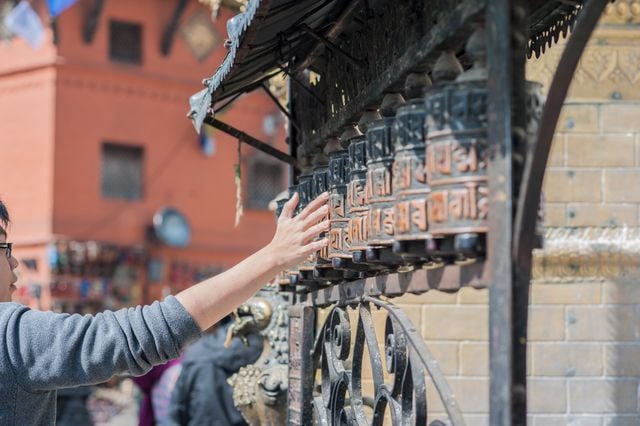
Walk clockwise around religious monuments. When moving around stupas, shrines, prayer wheels, or sacred structures, keep the monument on your right side. This is a common practice in Buddhist spaces and is easy for travellers to follow once they notice it.
Do not touch offerings, statues, prayer objects, or ritual items unless someone clearly invites you to. Some objects may look decorative to visitors but carry religious meaning for local people.
Avoid smoking inside or near sacred places. Even when there is no obvious sign, smoking around temples, monasteries, shrines, or ritual spaces can feel disrespectful.
How to Use Hands, Feet, and Gestures Respectfully
Use your right hand or both hands when giving or receiving something. This applies to money, food, tea, gifts, tickets, and small objects. Using both hands can make even a simple exchange feel more respectful.
Do not point with your feet. Feet are considered low and unclean in many Nepali cultural contexts, so using them to indicate a person, object, doorway, or sacred place can seem very rude.
Avoid stepping over someone’s legs if they are sitting on the floor. This is especially important around elders, in homes, and in informal village settings where people may sit together on mats or low seating.
Try not to point directly at people or sacred objects with one finger. A softer hand gesture is usually better, especially in temples, monasteries, or crowded cultural sites.
Keep your voice calm. Public anger, shouting, or visible frustration can make a situation worse and may be read as very bad manners. A calm tone, a smile, and Maaf garnus often do more than a loud complaint.
How to Take Photos Respectfully in Nepal
Ask before taking photos of people. Ke ma photo khichna sakchhu? [Can I take a photo?] is a useful phrase because it makes consent part of the exchange. A smile or nod is helpful, but it is still better to ask clearly when photographing someone directly.
Avoid using flash in sacred places. Flash can disturb rituals, damage the atmosphere of a quiet space, or make your presence feel intrusive.
Be especially respectful with monks, rituals, children, elders, and private homes. A temple ceremony, a family meal, or a child in a village is not the same as a mountain view. These moments belong to people before they belong to your travel album.
Consider giving something back in a thoughtful way, but avoid encouraging begging. Showing someone the photo, sending it later, buying from their shop, or supporting a community-run experience can be better than handing out money or sweets to children. Good intentions can create awkward habits when many tourists repeat them.
How Can a Native Teacher Help You Learn Nepali Before Your Trip?
A native teacher can help you learn Nepali as it is actually used, not only as a list of travel phrases. That matters because the same phrase can sound polite, casual, warm, too direct, or too formal depending on the person and the setting. A teacher can explain when Namaste is enough, when Namaskar may feel more respectful, how to use Dai or Didi naturally, and why a phrase that works with a guide may not be right for an elder in a village.
This is why a Nepali teacher can become a cultural guide as much as a grammar instructor. Lessons can include pronunciation, useful phrases, gestures, food etiquette, temple behaviour, trekking situations, and the small cultural details that phrasebooks often miss. You can practise how to refuse more food politely, how to ask for help on a trail, how to greet a host family, or how to ask before taking a photo.
At Language Trainers, we believe in keeping language learning human, whether lessons are face-to-face or online. With a language like Nepali, that human element matters because travel communication is rarely just about vocabulary. It is about tone, respect, timing, and confidence. A personalised Nepali course can be built around your trip, your interests, and the kinds of conversations you actually expect to have.
One traveller may want Nepali for trekking in Annapurna or Everest. Another may be preparing for a homestay, a temple visit, a business trip, volunteer work, or conversations with Nepali friends or family. A native teacher can adapt each lesson to those goals, so you spend time on the phrases and cultural situations that are most relevant to you.
That personalised approach can make progress feel much more visible. As Kanchen Shakya, who took a 35-hour Nepali course in Oxford, shared:
“My brother and I are really enjoying our Nepali lessons and I think we have come a long way since the start!”
If you are planning a trip to Nepal and want to feel more prepared before you arrive, contact Language Trainers to ask about a free trial Nepali lesson.
→Sign Up Now: Free Trial Nepali Lesson With a Native Teacher!←
5 Questions About Nepali Phrases for Tourists
1. Do people in Nepal speak Nepali or English?
People in Nepal speak Nepali as the official national language, and it is the most useful local language for tourists to learn. You will hear it in cities, villages, shops, restaurants, transport situations, trekking lodges, homestays, and everyday conversations across the country.
English is also common in many tourist areas, especially in Kathmandu, Pokhara, Thamel, Lakeside, hotels, travel agencies, restaurants, and major trekking routes. Many guides and tourism workers speak enough English to help with practical needs. However, English may be more limited in rural villages, remote trails, local buses, and family-run homestays. In those situations, phrases such as Namaste [Hello / Greetings], Dhanyabaad [Thank you], and Maile bujhina [I didn’t understand] can be genuinely useful.
2. Is Nepali hard for English speakers to learn?
Nepali can feel challenging for English speakers because it uses different sounds, sentence patterns, and a different writing system. Nepali is written in the Devanagari script, which may look unfamiliar if you have only studied languages that use the Latin alphabet. Sounds such as chha, bh, and longer vowels can also take practice.
That said, tourists do not need to master Nepali grammar or script before travelling. A small set of spoken phrases is very achievable. Start with useful expressions such as Namaste [Hello / Greetings], Dhanyabaad [Thank you], Kati ho? [How much is it?], Mitho cha [It is delicious], and Bistarai bhannus [Please speak slowly]. These phrases can help you communicate respectfully even at beginner level.
3. What is the most useful Nepali phrase to learn first?
The most useful Nepali phrase to learn first is Namaste [Hello / Greetings]. It works at almost any time of day and in almost any setting: hotels, shops, temples, trekking lodges, homestays, and village paths. Say it with your palms pressed together and a small nod to make the greeting feel warmer and more respectful.
A close second is Dhanyabaad [Thank you]. You will use it constantly: after receiving tea, food, directions, help with luggage, a room key, a ticket, or guidance on a trail. Together, Namaste and Dhanyabaad give travellers a simple but meaningful way to begin and end many interactions politely.
4. Can tourists use Nepali while trekking?
Yes, and trekking is one of the best situations for using Nepali. On major routes such as Everest, Annapurna, and Langtang, many guides, porters, lodge owners, and tourism workers speak some English. Still, Nepali phrases can make daily trail life easier and warmer, especially in smaller villages or family-run tea houses.
Useful trekking phrases include Bistarai bistarai [Slowly, slowly], Thakai lagyo [I am tired], Paani [Water], Khana cha? [Is there food?], and Kotha cha? [Is there a room?]. These phrases are practical, but they also show respect for the people who help make the trek possible: guides, porters, cooks, hosts, and lodge owners.
5. Will locals appreciate tourists speaking Nepali?
In many cases, yes. Nepali people often appreciate it when visitors make even a small effort to use the language. You do not need perfect pronunciation. A simple Namaste, Dhanyabaad, or Mitho cha said at the right moment can make someone smile because it shows that you are trying to meet them halfway.
The key is to stay humble and polite. Do not pretend to know more than you do, and be ready to laugh gently at your own mistakes. If someone corrects your pronunciation or teaches you a new phrase, take it as part of the experience. In Nepal, a few words can turn a practical exchange into a more human one.