Archive for Korean

Can you learn Korean in less than a day?

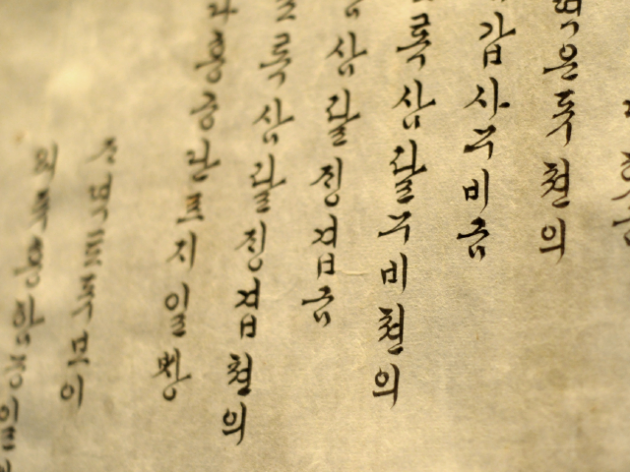
hangul2Well, the short answer is no.  However, it’s actually possible to learn how to read and pronounce hangul, the Korean written language, in a study session or two.

To the casual observer, hangul appears to be a pictographic script, like Chinese or ancient Egyptian. In actual fact, it’s an alphabetic language with fewer letters than English.  There are 14 consonants and 10 vowels in Korean, and they are grouped together to form written characters that represent single syllables.

There are some great resources out there for learning, and Joophas collected a few of them in this very comprehensive post.  If you go to the end of the post, there are some very useful links, as well as some beautiful script/pronunciation charts.

If you manage to associate each letter with its sound, and become familiar with how they fit together in script, you will be able to read Korean out loud in no time.  Of course, knowing what you’re saying is the next important step! 

Have you got any useful Korean language tips?

Comments

Resources: Chinese and Japanese character practice paper

For regular note-taking and writing practice, everyone has their own preferences for paper - lined or unlined, spiral bound, A4, A5, 100gsm.  Then there are the writing implements - pens, pencils, markers.  Some people prefer just to record audio, or use a laptop or netbook.  Even with all of these choices, when it comes to specialist paper for writing Asian characters, it can be difficult to find what you want if you don’t live in a place with a large Asian community.

I’ve found a few online resources for downloading and printing your own character practice pages, and will list them below.  Please add more in the comments if you know of any!

Dr Lili Worksheet - Character worksheet with spaces for name and date.  Grid with horizontal and vertical internal lines.  Has room under each line for writing pinyin/notes.

Dofufa practice paper - Character practice paper with three different sizes of grid.  Internal horizontal and vertical lines.

Incompetech free online graph paper - Probably my favourite resource for printing paper.  They have a lot of different kinds of graph paper, as well as note-taking paper and a few options for Chinese and Japanese character practice.  Their graph paper generator allows you to choose the size of your paper, the size of the grids, and even what colour you would like to print in.  Try printing in landscape for even more options.  My favourite is the Chinese Character Guide (X-style), which has room for writing pinyin as well as diagonal internal lines.

Good luck with the practice!

Comments

Visualising the WordNet

VisuWords

Back in 1985, cognitive scientists at Princeton University began work on a lexical database called WordNet.  It’s essentially a dictionary and thesaurus which groups and links words according to their meanings.  WordNet provides users with synsets, which are groups of words or phrases which essentially mean the same thing.  It’s a great tool for writers, students, language learners, and anyone who needs a definition, synonym, or broader view of a word or phrase.  WordNet is searchable online, and a downloadable application is also available.

A fantastic extension of WordNet is VisuWords, which allows you to see a visual interpretation of the WordNet links for words of your choice, or random words.  Each visual map shows the possible meanings and synsets for the central word and the relationships between them all.  It’s also interactive, allowing you to move parts around to see them more clearly, and synsets move around in quite a calming and hypnotic way.  The above image is what comes up when you plug ‘language’ into the search engine.

WordNet has inspired wordnets for many different languages, and a full list can be found on the Global WordNet Association website.  Many of them are browsable online (e.g. MultiWordNet On-line*), and some also have visual interfaces (e.g. Asian WordNet Project**, aimsigh.com (Irish)).  The GWA’s aim is to integrate as many wordnets together as possible, to make a global grid.

*Searchable in English, Italian, Spanish, Portuguese, Hebrew, Romanian, and Latin.
**Searchable in Japanese, Thai, Vietnamese, Lao, Bengali, Indonesian, and others.

Comments

Pish posh

When I was teaching some lovely Korean exchange students, one of the major pronunciation issues we had to work on was the difference between /p/ and /f/.  It was very difficult for them to differentiate the two, as they don’t have a /f/ sound in Korean.

We had a lesson about food, and I asked what they normally ate for dinner in Korea.  Rice and pish, I was told.  Fish? Yes, pish.  Do you like fish?  Yes, I like pish.

Some dedicated pronunciation drills followed.

It wouldn’t have been so bad if ‘pish’ wasn’t a common slang word in the UK and Ireland.  It is a somewhat polite version of ‘piss’, which, as well as meaning ‘urine’, is often used to talk about alcohol (usually beer).  In Australia, it’s quite common to ’sink some piss’ (drink some beer), and to be ‘pissed’ is to be drunk (but to be ‘pissed’ in the USA means to be ‘pissed off’ or ‘annoyed’).

So, in some places you can buy pish, drink pish, and get downright pished.   It does quite a good job of imitating a drunken (pished) slur, too.

‘Pish’ or ‘pish posh’ can also be a statement, meaning ‘rubbish!’ or ‘nonsense!’.

Comments off