Archive for Chinese

Chinese author wins Nobel prize for literature

Chinese author Mo Yan has won the 109th Nobel Prize for Literature. The Swedish Academy’s Permanent Secretary, Peter Englund, announced the winner and said that his work “with hallucinatory realism merges folk tales, history and the contemporary”.

Mo Yan, a pseudonym meaning “no name,” is well regarded in China as one of the greatest living authors.

The prize goes to the writer “who shall have produced in the field of literature the most outstanding work in an ideal direction.” His latest novel, Pow, is due to be released next year. The dual narrative intertwines the two stories and the book is described as comical.

Mo Yan’s most well renowned title is Red Sorgum, which is about the Japanese invasion of China in the 1930s, and was made into a film which is now considered a modern classic of Chinese cinema.

The declaration of the first Chinese citizen to win the Nobel will surely see increased interest in this writer’s works.


Interested in learning Chinese? Check out our Language Trainers course in Nottingham!

Comments off

Engrish no more!

The Commission for the Management of Language Use in Shanghai has reported that English sign accuracy has improved by 85% in the three years since its’ campaign launched to clear up any confusing signage in time for the Shanghai World Expo in 2010.

Signs such as  “inform police immediately – if you are stolen” have been removed by volunteer translation students.

Websites such as Cheezburger’s Engrish Funny have been set up to publish photos of translation errors in all languages snapped by tourists, and this has added to the notoriety of such gaffes.

Newspaper Shanghai Daily says that whilst there is a Chinese-language government website for reporting “Chinglish” crimes against English, there were “few channels for ex-pats to report incorrect English signs.”

Have you seen any badly translated signs? Please share in the comments!

Comments (1)

Berkshire school opens Mandarin teaching centre

A new Mandarin teaching centre opened at Wellington College in Berkshire on Saturday. The £500,000 centre is apparently the largest of it’s kind in the UK, and has a pagoda and Chinese water garden. The centre will not only teach students, but also host Chinese cultural events.

Liu Xiaoming, China’s ambassador to the UK, opened the centre as part of the schools’ Speech Day programme on Saturday. Speech Day honours outstanding students, with exhibitions of their work, sports displays and games, and prize ceremonies. Wellington College is a 150 year old independent school and is known for it’s Chinese links, as it has a sister school in Tianjin, near Beijing.

Comments off

New BBC show to introduce kids to languages

A new show on BBC channel CBeebies aims to teach pre-school age children about languages and their related cultures.

Eleven minute programme The Lingo Show features an animated bug named Lingo, as the “host” of the show. Lingo then introduces other bugs from other countries who sing little songs about their respective allocated language and culture within a live action set. Episode 1 introduces Wei, a bug which sings in English with Chinese Mandarin words interspersed. Through the use of songs and repetition, we learn that the Mandarin word for hello is nee hao.

The show isn’t especially logical, as it goes on to demonstrate the words for ice cream, banana, and yellow fan, red fan and blue fan, but hey, it’s for kids so I guess needs to keep their interest. It’s literally an introduction, and doesn’t overwhelm with too many words. The series doesn’t look at a different language each episode either, which is great for continuity.

There are other “characters,” each of which will introduce a different language. The languages they represent are Spanish, Somali, French, Punjabi, Welsh, Polish, and Urdu.

You can watch episodes on the BBC iPlayer here.

Comments off

Gift Ideas Part 1

It’s that time of year again, where we’re all trying to think of fabulous Christmas gifts for family and friends. Don’t worry, I won’t be making these a regular thing all the way through December! I’ve just discovered these magnets which would make a great gift for any language student, and thought I’d share!

These little Magnetic Poetry Kits now come in Spanish, French, Italian, German, Norwegian and Swedish, and are a fun way to practice your writing skills in another language. There’s also a Hebrew alphabet kit, a sign language kit, and a Chinese for Kids kit, but these are a little harder to find.


These are available from Amazon, Eurocosm, and directly from Magnetic Poetry (this is a US site)

Comments off

Which is the most efficient language?

Language journal has published a study by three linguists at the University of Lyon, showing that certain languages are more or less equally efficient.

The study compared the efficiency of conveying information in spoken German, Mandarin Chinese, Japanese, English, French, Italian, and Spanish.

Researchers took a sample group of 59 people, who each read a sample text in their native language. The recordings were then edited to remove the pauses, and syllables were tallied in order to draw conclusions regarding the density of information communicated in each language.

Japanese was found to be the fastest spoken language, with 7.84 syllables spoken per second. Mandarin Chinese was the slowest, with the average syllabic speech rate at 5.18. However, the researchers note that in ‘faster’ languages, the individual parts of words are shorter, meaning there are more syllables. They concluded that a higher rate of syllables by no means implies that content can be transmitted more quickly.

A more comprehensive study, carried out by University of Klagenfurt linguistics professor Gertraud Fenk-Oczlon in 2010, reached similar conclusions. In this case, 51 different languages were recorded, with Indian language Tegulu found to be the fastest, and Thai the slowest.

The latest study, in more detailed form, can be found here.

Comments (1)

The opposite of Chinglish

One of the many things I find fascinating about living in China is seeing how the foreigners deal with the language. For many people, the only Chinese they know will get them home in a taxi and maybe to a drink at the pub. There are some Chinese words, though, that become part of daily usage for non-native speakers regardless of their language level. Sometimes they are simply Chinese words for things we don’t have in other countries (mostly region-specific foods and dishes). Sometimes they are an interesting reflection of the way life is here.

One of the words in the ‘interesting’ category is 麻烦 (máfan). It basically means trouble. You can also say máfan nǐ, which means ‘Can I trouble you?’ Most foreigners, however, can be heard to say that something is too much máfan, e.g. “I don’t travel in China because it is too much máfan.” There’s something in the Chinese phrase that encapsulates the frustration along with the trouble.

Another common thing to do is to use Chinese verbs in an English way, by adding suffixes like -ing and -ed. The other day, a friend was talking about how Shanghai has been 发展-ing (fāzhǎn-ing) really fast lately. Fāzhǎn means development, or to develop. “There’s been a lot of fāzhǎn around here lately.”

What’s your favourite foreign word that’s made it into your everyday vocabulary?

Comments (2)

Embarrassing mix-ups

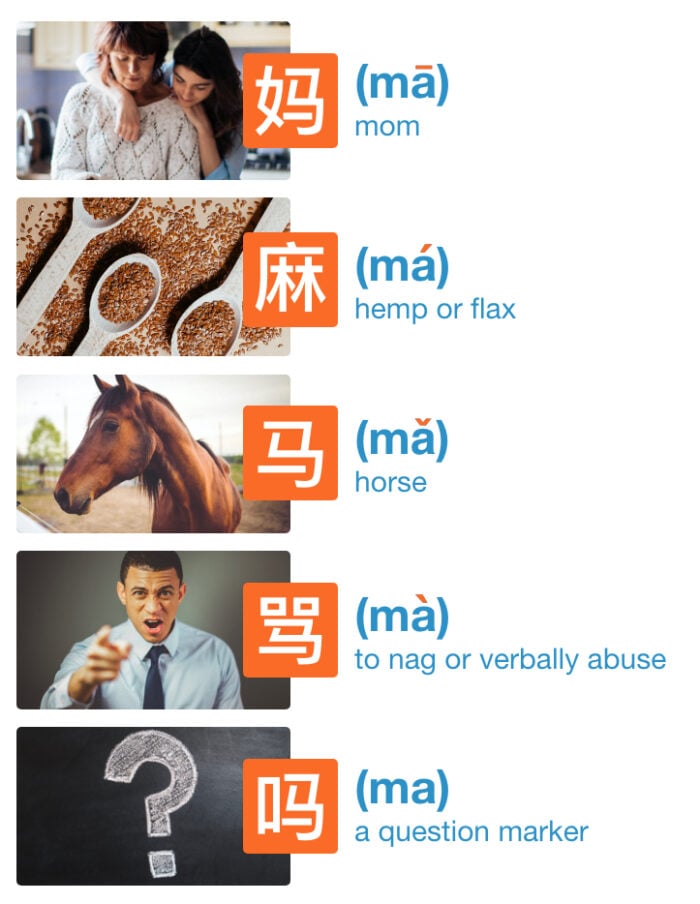
Chinese is one of those languages where just getting a tone wrong can result in something completely different from what you’d intended, although every language has certain words that are very easy to mix up. The worst is when you are absolutely convinced that you are using the correct word, but it turns out that you just asked for something ridiculous.

The other day, I was telling my teacher that it was OK to eat steak rare, as long as it’s fresh (鲜, xian with a high tone). Unfortunately, it sounded like I was saying 咸 (xian with a rising tone, meaning ‘salty’). Obviously, it’s easy to be misunderstood in these situations (and I need to be more careful with my pronunciation).

My teacher then told me a story (I think to make me feel better about my slip up) about a mistake that one of her other students had made. Apparently he was convinced that the word for aubergine (茄子 qié zi) was 孩子 (hái zi, meaning child). So, when he went in to a restaurant and asked for fried child with his rice, the proprietors were so freaked out about a big foreigner asking for something barbaric that they told him they were closed and pushed him out the door. It wasn’t until he wondered why my teacher had been playing with an aubergine (when it was really a child) that he realised his error.

What was your most hilarious (or embarrassing) mix up?

Comments (3)

Happy Chinese New Year 兔 you

Chinese New Year, or Spring Festival, is starting this week. The biggest celebration of the Chinese calendar, it is a time for families to get together and ring in a prosperous new year. Many of the traditions associated with the festival have grown up around words that sound like each other. The Chinese are big on wordplay, which is totally fine by me. For example, it is common to eat fish and leave some for the new year, because the Chinese word for fish, 鱼 (yu2),has the same pronunciation as the word for surplus, 余. So if you say the phrase 年年有余兔 (nian2 nian2 you3 yu2), meaning ‘may there be surpluses every year’, it sounds exactly like 年年有鱼, ‘may there be fish every year’.

There’s also been a really interesting crossover of these double meanings using English and Chinese. A couple of years ago it was the year of the ox, or 牛 (niu2, which sounds a lot like the English word ‘new’). Greetings of ‘Happy 牛 Year’ abounded. Now that it is almost the year of the rabbit (兔, or tu2), I’ve seen ‘Happy New Year 兔 you’. I think it’s very creative and linguistically interesting. I wonder what people will come up with for the other zodiac animals!

Comments (2)

Try, try again (or, my Achilles heel)

taxi driverI usually don’t have a problem getting around in taxis and having basic conversations in Chinese. Apparently my pronunciation is generally pretty good, even though I sometimes still have problems with differentiating the tones. So I was kind of surprised to find a street name that taxi drivers almost never understand when I tell them. It’s not a small street, and it even has a subway station with the same name. It also happens to be the street that I now live on.

I said the street name over and over again in my head, looked up the tones to make sure I was getting them right, but no matter how much I practised (in my head and out loud), as soon as I say it to a taxi driver, he has no idea what I’m talking about, and I get really flustered. Maybe I’ve just started saying it with a sort of hopeful lift at the end, which is definitely not the tone I’m going for. Even worse, they understand it when my boyfriend clarifies, and he barely speaks two words of Chinese.

I know I’m just going to have to keep at it until I get over the mental block I’ve now put in front of the words, but in the meantime, it’s a bit of a struggle to get home. Maybe I’ll just have to start taking the bus.

Comments

« Previous entries Next Page » Next Page »